Oct. 27, 2026
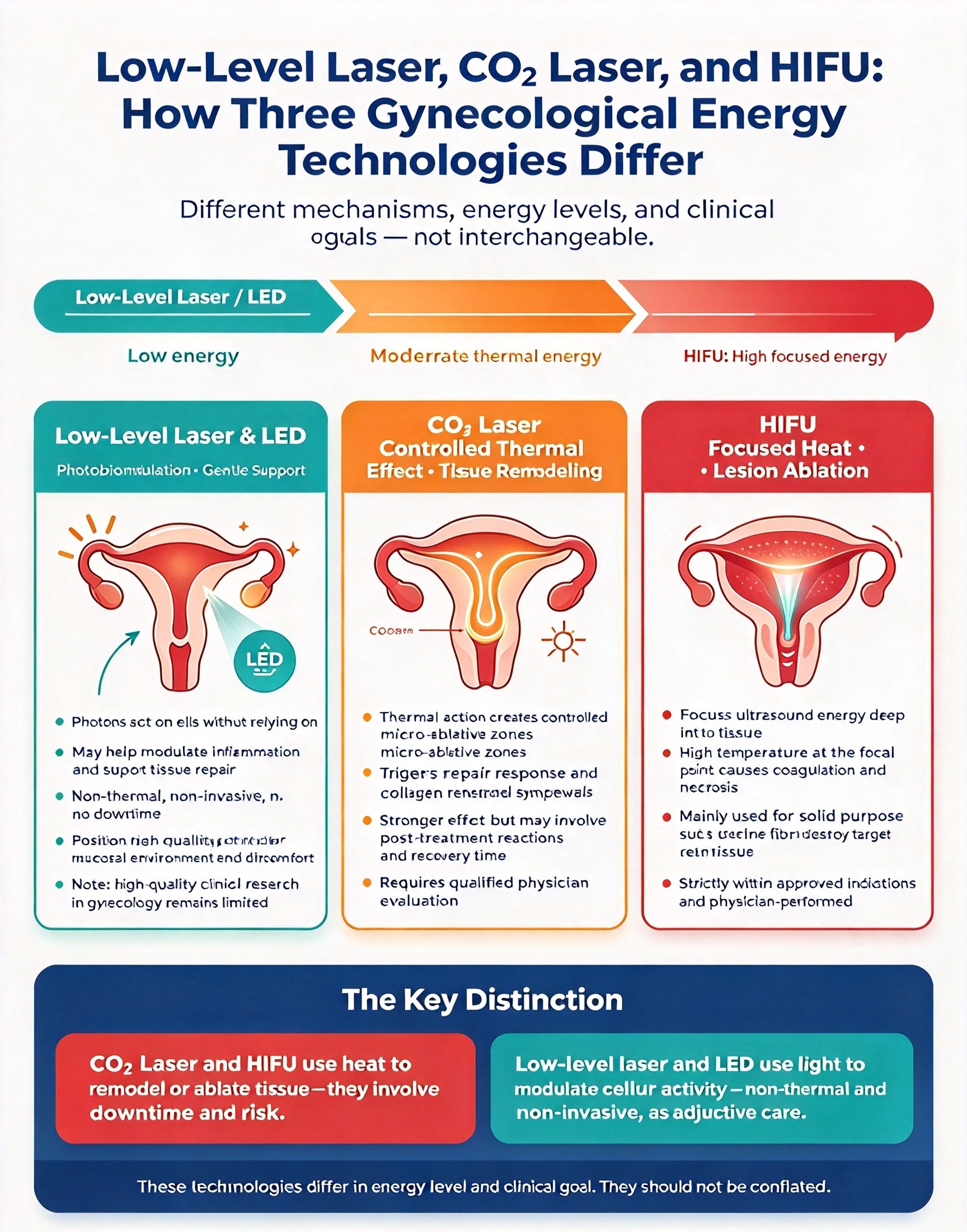
In the field of feminine intimate health, low-level laser (e.g., 650nm laser combined with 450/660/850nm LED), CO₂ laser, and high-intensity focused ultrasound (HIFU) are often mentioned side by side — yet their mechanisms, energy levels, and clinical positioning are fundamentally different. Low-Level Laser & LED: Photobiomodulation for Gentle Support This category belongs to photobiomodulation (PBM). Low-energy photons act on cells to help modulate inflammatory responses and support tissue repair, without relying on thermal effects to damage tissue. It is non-thermal, non-invasive, and requires no downtime, and is positioned as an adjunct to improve the mucosal environment and ease discomfort such as dryness. It should be noted that high-quality clinical research on PBM in gynecology remains limited; its value is best understood as gentle supportive care rather than structural change. CO₂ Laser: Controlled Thermal Effect for Tissue Remodeling CO₂ laser creates controlled micro-ablative zones in the superficial mucosa through thermal action, triggering a repair response and stimulating collagen renewal to improve symptoms related to mucosal atrophy. It is a thermal device with a stronger effect, but it is typically associated with post-treatment reactions and a recovery period, and should be performed only after evaluation by a qualified physician. HIFU: Focused Heat for Lesion Ablation High-intensity focused ultrasound focuses ultrasound energy onto deep tissue, generating high temperatures at the focal point to coagulate and necrose the target tissue. It is primarily used for ablating solid lesions such as uterine fibroids and adenomyosis. With the highest energy level, its purpose is to destroy target tissue — it is not in the same application category as routine mucosal care or intimate tightening, and must be performed by physicians strictly within approved indications. The Key Distinction CO₂ lasers and HIFU use heat to "remodel" or "ablate" tissue, and they involve downtime and risk. Low-level laser and LED use light to "modulate" cellular activity — non-thermal and non-invasive — and are intended as an adjunct to improve the mucosal environment and ease discomfort. The three differ in energy level and clinical goal, and should not be conflated.