Oct. 29, 2026
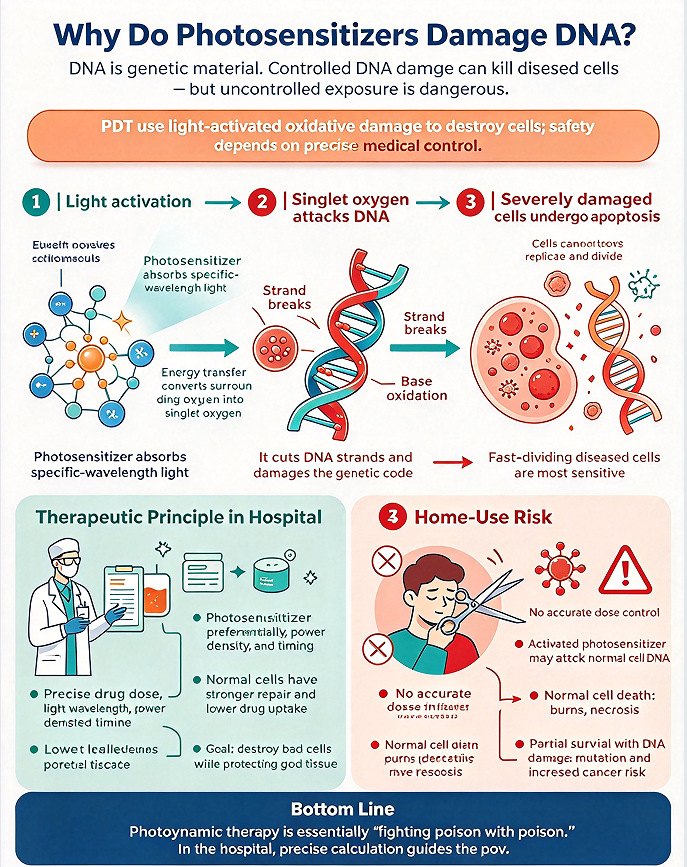
DNA is indeed the genetic material. And photosensitizers kill cells precisely by deliberately damaging DNA — this is the core principle behind how they treat disease, and it is also the fundamental reason they are dangerous.
Let's break the process down so it becomes clear:
1. How does the photosensitizer "demolish" DNA at a designated spot?
After entering the cell, the photosensitizer is activated by light of a specific wavelength (such as the 450 nm blue light you mentioned). It then undergoes energy transfer, turning the surrounding oxygen into "singlet oxygen" (an extremely toxic type of free radical).
This substance acts like a pair of microscopic scissors: it directly attacks the DNA molecular chain, cutting the chemical bonds (causing strand breaks) or oxidizing the bases (corrupting the genetic code).
2. Why damage DNA? (The therapeutic logic)
Once a cell's DNA is severely damaged, it can no longer replicate and divide, and its only option is to launch its "suicide" program (apoptosis).
Tumor cells and abnormally proliferating cells divide extremely fast and are the most sensitive to DNA damage. Medicine therefore exploits this mechanism to precisely destroy the DNA of diseased cells, causing them to die "without descendants," while normal cells are less affected because of their stronger repair capacity and the smaller amount of photosensitizer they accumulate.
3. Why is this extremely dangerous in home use?
Because the photosensitizer has no "eyes." It merely accumulates preferentially in diseased tissue, but it cannot stay there 100% of the time.
l If the dose is not accurately controlled during home use, the activated photosensitizer will attack the DNA of normal cells indiscriminately.
l This directly causes the death of normal cells (burns, necrosis). Even more frightening, if the DNA is partially damaged but the cell survives, a gene mutation has occurred — and accumulated over the long term, this can actually raise the risk of cancer.
To sum it up in one sentence: photodynamic therapy is in essence "fighting poison with poison" — using controlled DNA damage to kill bad cells. In the hospital, the physician's precise calculations ensure that the "poison" attacks only the bad cells; doing it yourself at home is like cutting clothes with scissors with your eyes closed — you will almost certainly cut the good fabric, and you will also leave behind fatal loose threads (mutations).