Feb. 25, 2026
In pain management, lasers of different wavelengths have specific functions and focal applications due to their varying penetration depths and biological
mechanisms. Here is a comparison of the primary functions of **808nm** and **650nm** lasers in pain treatment:
### 1. 808nm Laser (Near-Infrared Laser)
Core Function: Deep Tissue Therapy, Anti-Inflammation, and Analgesia**
Mechanism and Characteristics:**
Deep Penetration:** 808nm is a near-infrared light, offering the deepest tissue penetration (typically several centimeters). It can directly reach deep
pain sources such as muscles, ligaments, joints, and nerves.
Photobiomodulation Effect:** It is primarily absorbed by intracellular components like **cytochrome c oxidase**, leading to:
Significant promotion of ATP synthesis**, increasing cellular energy and accelerating tissue repair.
Potent Anti-inflammatory Effect:** Inhibits the production of inflammatory mediators like prostaglandins and TNF-α, reducing inflammation.
Analgesia:** Relieves pain through multiple pathways: reducing nerve excitability, alleviating tissue edema and inflammation, and promoting endorphin release.
Improved Microcirculation:** Enhances local blood flow, removing pain-inducing substances and delivering nutrients.
Main Applications in Pain Treatment:**
Deep Tissue Pain:** Frozen shoulder, knee arthritis, lumbar muscle strain, discogenic pain.
Chronic Inflammatory Conditions:** Tendinitis, bursitis, ligament injuries.
Adjuvant Therapy for Neuropathic Pain.
Postoperative Pain and Swelling Reduction.
**Simple Summary: The 808nm laser is the "main force" in pain treatment, specialized in addressing pain caused by deep muscle, joint inflammation, and injury.**
### 2. 650nm Laser (Red Laser)
Core Function: Superficial Tissue Repair, Anti-Inflammation, and Wound Healing Promotion**
Mechanism and Characteristics:**
Superficial Penetration:** 650nm is visible red light with shallower penetration (typically millimeters to about one centimeter). It primarily affects superficial tissues like skin, subcutaneous tissue, and mucosa.
Efficient Absorption:** Its photons are readily absorbed by **mitochondria** and **hemoglobin**.
Primary Biological Effects:**
Promotes fibroblast proliferation and collagen synthesis**, accelerating superficial tissue repair and wound healing.
Anti-inflammatory and Edema Reduction:** Effective for superficial inflammation.
Improves local microcirculation.**
Analgesic effect** is relatively weaker compared to 808nm and is mainly for superficial pain.
Main Applications in Pain Treatment:**
Superficial Pain:** Skin wound pain, mouth ulcers, superficial dermatitis, postherpetic neuralgia (skin lesion areas).
Adjuvant Therapy:** Often used in combination with 808nm lasers to address superficial inflammation and skin repair at the pain site.
Acupoint Irradiation:** Due to its suitable penetration depth for stimulating acupoints, it is commonly used in laser acupuncture therapy.
**Simple Summary: The 650nm laser is a "superficial repair specialist," mainly used for inflammation, injury, and related pain in superficial tissues like skin and mucosa. It often serves as a supplement to deep tissue therapy.**
Comprehensive Comparison and Clinical Combination Therapy
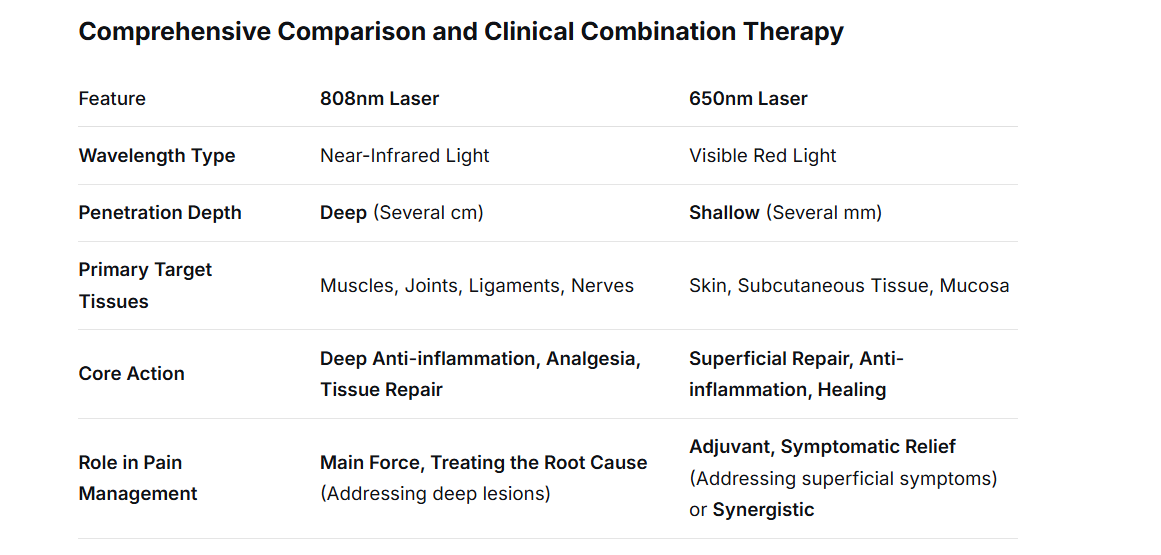
In clinical practice, a **"combination therapy"** strategy is often employed for optimal results:
* Combined Use of 808nm + 650nm:** This can simultaneously cover tissues from superficial to deep. The 650nm addresses skin and superficial inflammation,
while the 808nm treats the core deep lesion, achieving **three-dimensional, comprehensive analgesia and repair**. This combination is very common in composite
pain therapy devices.
**Conclusion:**
In pain treatment, **the primary function of the 808nm laser is to address deep inflammation and tissue damage for fundamental anti-inflammatory, analgesic, and
repair effects.
The primary function of the 650nm laser is to manage inflammation in superficial tissues, promote healing, and often serve as an adjunct to deep therapy.*
* Using them in combination can provide more comprehensive and effective pain relief and tissue rehabilitation.