Feb. 25, 2026
The parameters you mentioned, "peak power 25W, average power only 20mW," represent the most core characteristic of the 904nm laser: high-frequency pulsed output. It does not emit light continuously but rather sends out extremely high-power pulses in a very short time (nanoseconds), followed by a long "rest" period.
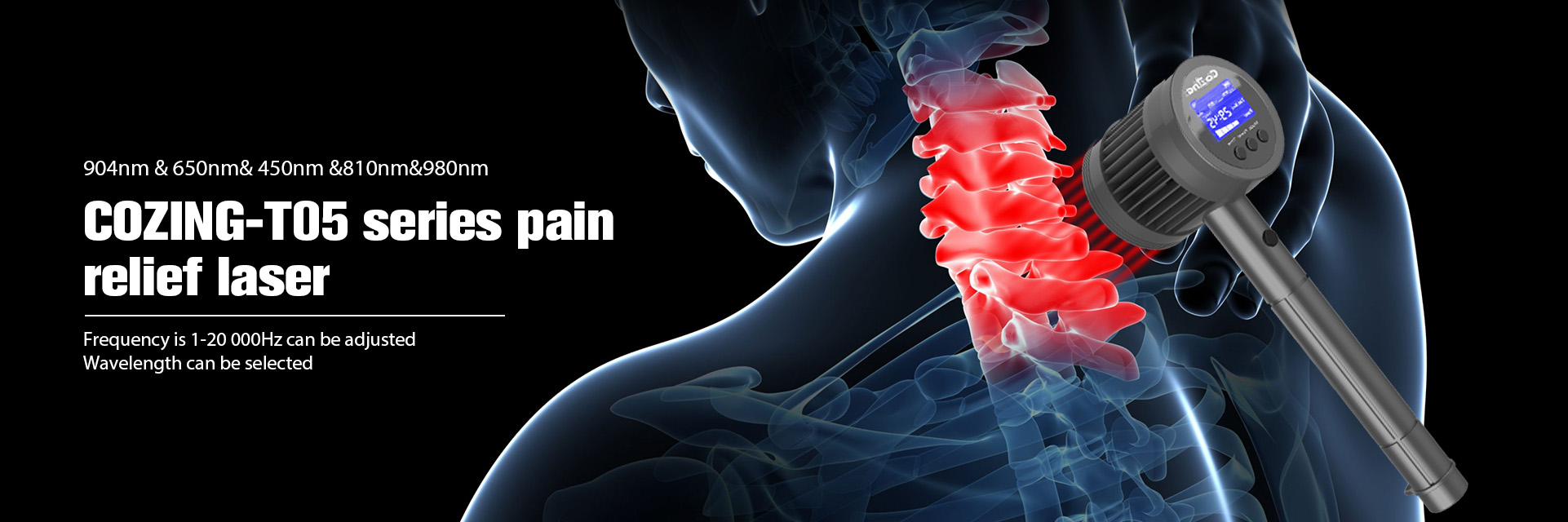
The core mechanism of the 904nm (Gallium Arsenide, GaAs) laser in pain therapy is photobiomodulation, not a thermal effect. Its high-frequency pulse characteristics allow it to trigger a series of biological reactions more effectively.
Strong Penetration, Reaching the Lesion Directly: High peak power (25W) pulsed light can form powerful photon streams that penetrate the skin and fat, reaching deep muscles, nerve roots, and joints directly. This allows it to effectively treat pain in deep tissues, not just on the surface.
Neural "Gate" Regulation: Pulsed light can effectively stimulate the substantia gelatinosa in the spinal cord's dorsal horn. According to the "Gate Control Theory," it preferentially activates thick Aβ fibers, "closing the gate" to pain signals (transmitted by C fibers) ascending to the brain, thus producing rapid analgesic effects.
Release of Endogenous Analgesics: Research shows that 904nm laser can promote the release of endorphins and enkephalins. These are the body's natural "morphine-like" substances that bind to opioid receptors, producing lasting, non-addictive deep pain relief.
Anti-inflammation and Cell Repair: Pulsed light effectively stimulates mitochondria, increasing ATP (Adenosine Triphosphate) production, providing energy to damaged cells, and accelerating tissue repair. Simultaneously, it inhibits the activity of inflammatory factors (such as TNF-α, IL-1β), reducing local sterile inflammation.
Improves Microcirculation: Promotes the release of nitric oxide (NO), dilating local capillaries, accelerating the metabolism and clearance of pain-causing substances (like bradykinin, serotonin), thereby "cleaning up" the pain environment.
This special pulsed mode brings several crucial clinical advantages:
Feature | Explanation & Advantage |
Deep Penetration, Superficial Layer Intact | The 25W peak power provides the "energy passport" needed to penetrate deep tissues. However, because the pulses are extremely short and the average power is only 20mW, the heat generated is minimal. Therefore, the skin surface is completely safe from burns. This achieves the ideal effect of "deep treatment with no superficial sensation." |
Peak Power Triggers Biological Effects | Many photobiomodulation processes, such as activating mitochondria or opening ion channels, require an intensity "threshold." High peak power pulses easily cross this threshold, efficiently initiating cell repair and analgesic signals. |
Avoids Thermal Damage and Tolerance | The low average power ensures treatment safety, avoiding tissue damage or discomfort that could result from heat accumulation produced by continuous wave lasers. Additionally, the pulsed mode gives tissues time to rest, making it less likely to induce biological tolerance, thus ensuring long-term efficacy. |
The 980nm laser can operate in both continuous wave and pulsed modes. Its mechanism of action shares similarities with the 904nm but also has distinct differences, with its biggest feature being its interaction with water.
Multi-level Opioid Receptor Activation: This is a unique mechanism of 980nm analgesia. Research from 2023 indicates that the analgesic effect of the 980nm laser depends on the involvement of opioid receptors in both peripheral tissues (local injury site) and the central nervous system (ventromedial nucleus of the thalamus). This explains why it can produce bilateral analgesia—meaning that irradiating one side can reduce pain on the opposite side, showing clear characteristics of central analgesia.
Mild Thermal Effect and Decompression via Water Absorption: Unlike 904nm, the 980nm wavelength is readily absorbed by water (its absorption coefficient is 5 times higher than that of 810nm). This allows it to produce a gentle warming effect in water-rich tissues (such as the intervertebral disc nucleus pulposus, muscles), helping to relax muscles and relieve spasms. In Percutaneous Laser Disc Decompression (PLDD), a 980nm optical fiber is inserted into the disc. Its heat can vaporize a small amount of the nucleus pulposus, rapidly reducing intradiscal pressure, thereby instantly relieving mechanical compression on the nerve root. This type of "minimally invasive procedure" analgesic effect is unmatched by other wavelengths.
Basic Photobiomodulation Effects: Similarly, 980nm can be absorbed by mitochondria to produce ATP, improve circulation, and exert anti-inflammatory effects.
Dimension | 904nm High-Frequency Pulsed Laser | 980nm Semiconductor Laser |
Core Mechanism | Photobiomodulation (Non-thermal) | Photobiomodulation + Mild Thermal Effect / Water Absorption |
Action Characteristics | High pulse peak achieves deep penetration, regulates neural "gate," stimulates endorphins | Activates peripheral and central opioid receptors for central, bilateral analgesia; creates unique physical effects via water absorption |
Tissue Interaction | Stimulates deep nerve roots, deep joints; no risk of thermal damage | Acts on water-rich tissues (discs, muscles); can produce mild thermal relaxation or disc decompression |
Clinical Advantages | Deep analgesia with absolute superficial safety, suitable for various acute/chronic deep pain, neuralgia | Preferred for discogenic pain (e.g., lumbar disc herniation) in minimally invasive treatment; broad musculoskeletal pain management |
Parameter Significance | Peak 25W / Average 20mW: The golden combination for achieving "deep penetration + absolute safety + efficient biostimulation" | Power adjustable (continuous/pulsed), flexible selection based on treatment goal (warming/photobiomodulation) |
In summary: The 904nm high-frequency pulsed laser, with its unique "high peak, low average" parameter, acts like a precise "biological switch," safely and deeply regulating nerve function and cellular metabolism. It is an ideal tool for managing deep neuropathic pain. The 980nm laser, on the other hand, acts like a "versatile all-rounder." It not only provides central analgesia through opioid pathways but also leverages its water absorption properties to address issues in specific structures like the intervertebral disc.