Nov. 09, 2026
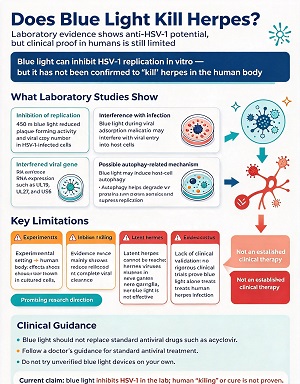
European and American laboratory studies show that blue light at specific parameters can inhibit the replication and activity of herpes simplex virus type 1 (HSV-1) in in vitro cell experiments, but this is still a long way from clinically proving that it can "kill" the virus in the human body, and it is by no means a mature treatment option.
Current evidence remains largely at the laboratory stage, and it mainly targets HSV-1, with limited data on HSV-2. Below is a detailed analysis based on European and American research data:
Laboratory evidence: blue light does show anti-HSV-1 activity
Multiple in vitro studies have observed that blue light has an inhibitory effect on HSV-1, but the mechanism is not directly "killing" virus particles; rather, it mainly interferes with the infection and replication process.
Inhibition of viral replication and gene expression: A 2023 study published in the Journal of Photochemistry and Photobiology B found that 450 nm blue light irradiation specifically reduced plaque-forming activity and viral copy number in HSV-1-infected cells, and inhibited the RNA expression of viral genes such as UL19, UL27, and US6. Another 2024 study further confirmed that daily blue light irradiation (10 J/cm²) significantly reduced HSV-1 viral titers and produced a synergistic inhibitory effect with the antiviral drug acyclovir.
Interference with viral entry or damage to the virus: The above-mentioned 2023 study also noted that blue light irradiation during the viral adsorption phase may interfere with viral entry into host cells or cause some damage to the virus itself.
Proposed mechanism of action: Studies speculate that the antiviral effect of blue light may be related to the induction of autophagy in host cells; autophagy helps degrade viral proteins, thereby inhibiting viral replication.
Key qualifications: what these findings mean and do not mean
Experimental environment ≠ human environment: The above experiments were all conducted in cultured cells (such as Vero cells and human keratinocytes). Whether blue light can penetrate human skin or mucosa to reach an effective antiviral concentration without damaging normal tissue is a core unresolved question.
"Inhibition" ≠ "killing": What has been observed in the studies is mostly inhibition of viral replication and a decrease in titer, rather than complete clearance of the virus. Herpes viruses lie latent in nerve ganglia, and blue light cannot reach these latent viruses; therefore, it cannot "cure" herpes or prevent recurrence.
Lack of clinical validation: Among the European and American studies retrieved so far, there are no rigorously designed clinical trials proving that blue light therapy can effectively treat human herpes infection. Only one 2025 case report mentioned a successful case of blue light photodynamic therapy using curcumin as a photosensitizer for recurrent labial herpes, but this is a combination photodynamic therapy, and the level of evidence is very low, so it cannot be used as evidence that blue light alone is effective.
Conclusion
Under laboratory conditions, blue light does show potential to inhibit HSV-1, but the claim that it can "kill herpes virus" has not yet been confirmed in human applications. It is currently a promising research direction, rather than a clinical therapy that can replace standard antiviral drugs (such as acyclovir). If you or someone else is suffering from herpes, you should follow a doctor's guidance and receive standard antiviral treatment, and should not readily believe in or try unverified blue light devices on your own.
Previous: None
Next: Why do photosensitizers damage DNA? Isn't DNA the genetic material?